A Life Woven Across Oceans: Beth & Brink Harrison’s Journey from Kyoto to Maine
In October, JCAM had the joy of sitting down with Beth and Brink Harrison, two people whose lives have been shaped profoundly by Japan, by curiosity, and by the communities they’ve called home. Today, they are beloved members of the Maine Taiko community. But their story spans Kyoto, Arizona, Minnesota, and now Maine, with Japan always at the center. What follows is the story they shared with us: a portrait of two people whose decades of connection to Japan shaped not only their careers, but also the way they raised their children, built friendships, and found their home in Maine.
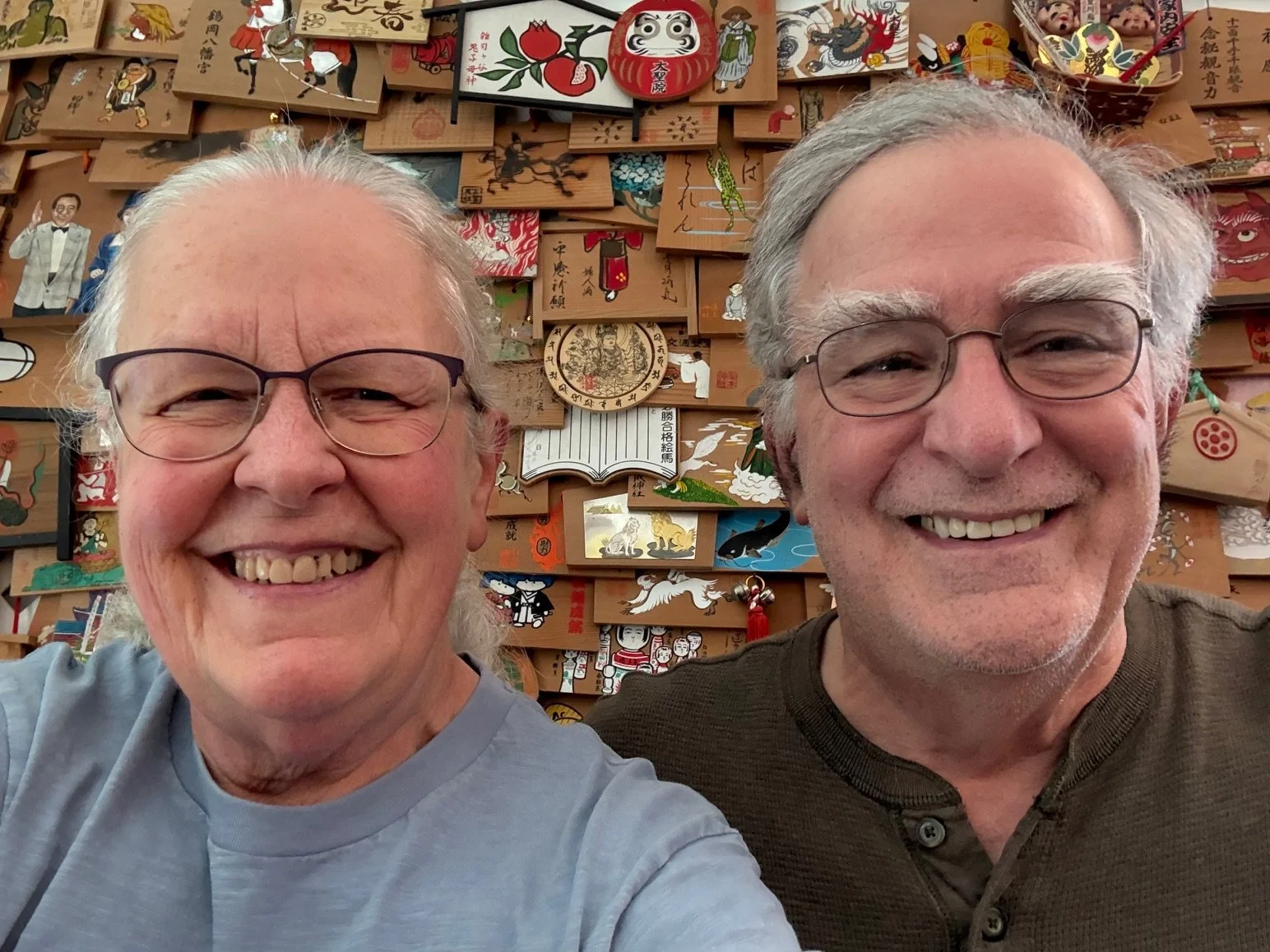
Beth (Left) and Brink (Right)
From Minnesota to Seoul to Okinawa: A Childhood Shaped by Movement
Beth’s story begins far earlier than her first trip to Japan. As a child, she lived in South Korea during the late 1950s while her father, a medical educator, worked to rebuild Seoul National University’s medical and nursing programs in the aftermath of war. Her early memories are punctuated by details that reveal just how complex that time was: living off-base during the first year, then relocating to U.S. Army housing during a military coup; practicing blackout drills at night; watching her mother prepare passports and suitcases “just in case they had to flee quickly.” Yet what she recalls most fondly is the warmth of Korean families, the food they shared, and her parents’ insistence on being part of local life and not just the American community. Later, her family would move again—this time to Okinawa. Her parents, both medical doctors, worked with the University of Hawaii and local institutions to build specialty training programs so Okinawan doctors no longer had to leave the island (and often never return) to pursue advanced training. While her parents worked, Beth absorbed the rhythms of daily life, the taste of rice cooked in an Okinawan kitchen, and the sight of her mother traveling across the island to treat patients who were too often hidden away because of physical disabilities. These early years, filled with movement, culture, and language, would quietly set the stage for everything that came next.
Falling in Love with Japan (and with Each Other)
Despite her international upbringing, Beth didn’t plan on studying Asian Studies in college. That changed, however, when she found a flyer for a summer program in Japan. A single decision to take an introductory Japanese class and join a homestay program became the turning point of her life. She fell in love with the language, with Kyoto, with the quiet rhythms of daily life, and with the grace and curiosity of her host family. She stayed six months, then returned again for the very first year of the Associated Kyoto Program (AKP), eventually spending nearly two full years of her undergraduate experience in Japan. And then, another unexpected turning point, she returned to Carleton College for her senior year and met Brink. They were engaged by December. Married by June. And beginning a journey together that would span 51 years (and counting).
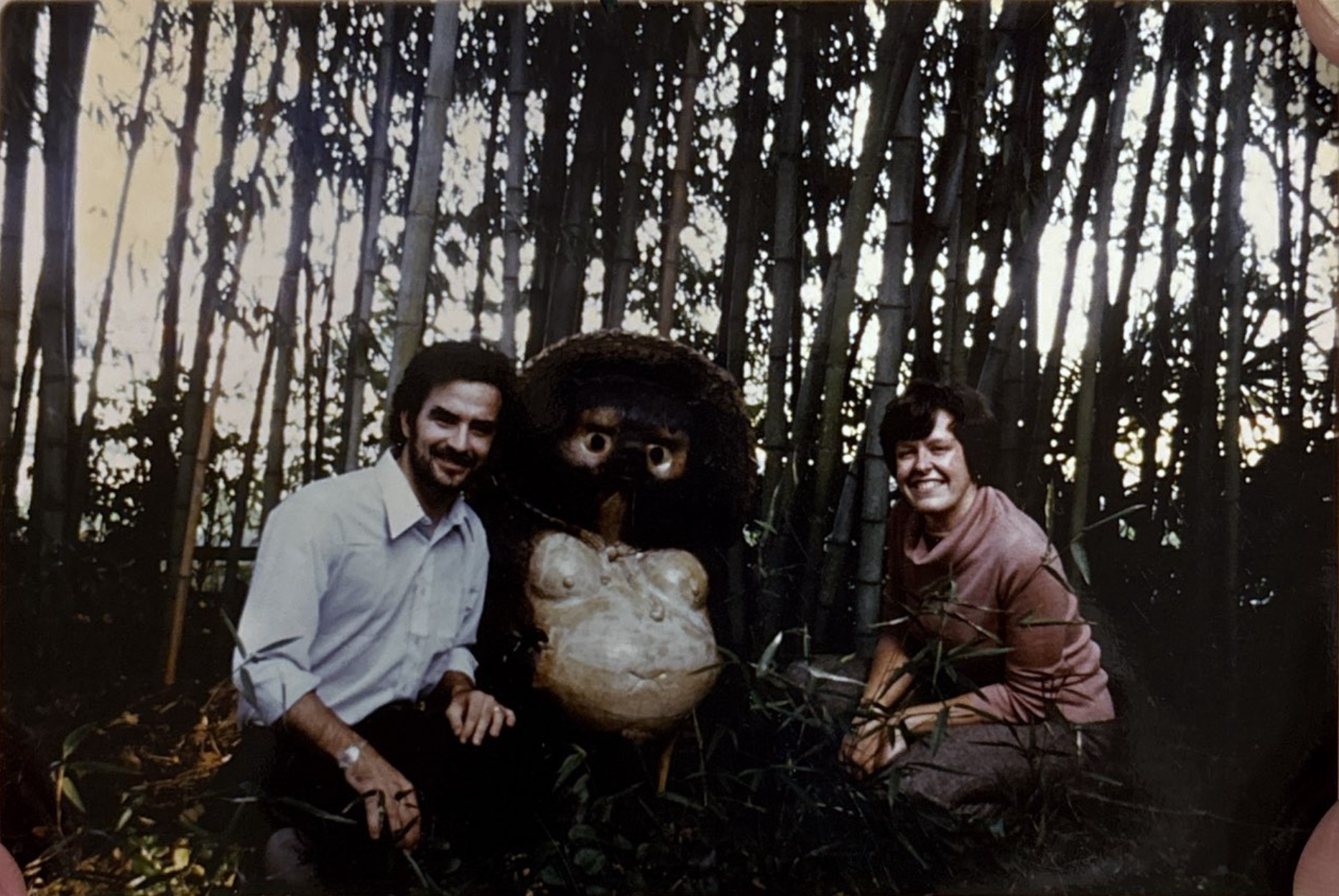
Beth and Brink with Tanuki (Japanese Raccoon Dog) in Japan.
11 Years in Kyoto: Raising Bilingual Children & Building a Life
After graduate school at the University of Chicago, the Harrisons moved to Kyoto for Beth’s dissertation research. A Fulbright grant allowed them to settle there long-term. What began as a research stay became eleven years of life. They lived first in Shugakuin near the mountains, then right beside the Kyoto Imperial Palace grounds. Their sons, blonde and blue-eyed, grew up speaking fluent Japanese, attending hoikuen, navigating neighborhood shopping streets, and learning which playgrounds had the best places to climb. To their Japanese classmates, their foreign faces mattered far less than the fact that they were both kids of their own community. Their memories of Kyoto are not simply nostalgic, but textured: evenings of bicycle rides past the Gosho and the long walks on the Shikoku pilgrimage route. The feeling of deep belonging as a family both inside and outside Japanese society. These years remain at the heart of who they are.
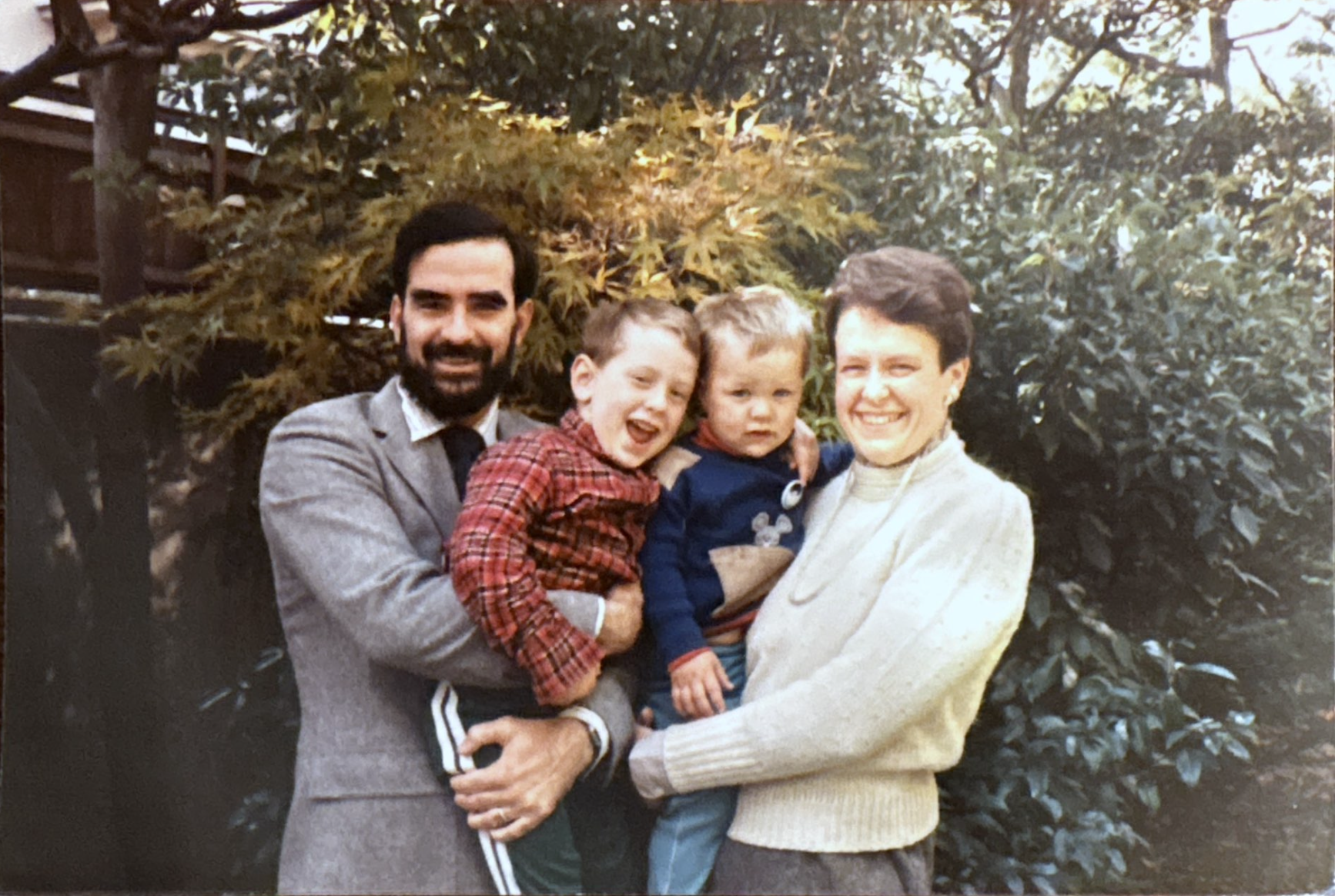
The Harrison Family in Kyoto.
Taiko Arrives Later, But Stay as a Lifelong Rhythm
Surprisingly, they didn’t begin Taiko drumming in Japan. Instead, Taiko entered their lives in a university auditorium in Tucson, Arizona. Beth had been invited to judge a Japanese speech contest. During intermission, a local community Taiko group performed. They announced afterward that anyone could join. Beth walked past Brink and whispered, “Go talk to them.” That single moment was the start of their Taiko journey. They played in Tucson, then in Phoenix, then, after a long pause during their years in Ohio, finally again in Maine. Today, the Harrisons have become important members of the Maine Taiko community.
Why Maine? A Place That “Felt Like Home”
After long careers in academia and decades in the desert warmth of Tucson, Beth and Brink wanted something different when planning retirement. They didn’t want heat or humidity. They didn’t want Florida or North Carolina. They wanted cold; the kind they remembered from Minnesota and Chicago. More importantly, they wanted a college town with a strong sense of community. They explored Vermont, New Hampshire, Pennsylvania, and Massachusetts. But Maine, especially Brunswick and Portland, felt right from the moment they arrived. They describe it simply: “It felt like home.” That feeling, combined with proximity to their sons’ families along the East Coast, made Maine the perfect place to build the next chapter of their lives. After years of moving across continents, raising bilingual children in Kyoto, discovering Taiko in the Arizona desert, and finally choosing the cold, quiet beauty of Maine, Beth and Brink have built a life stitched together by curiosity, community, and culture. When Maine Taiko restarted after the pandemic, Beth reached out; and from the very first practice, it felt like the beginning of something familiar. Something that had been waiting for them. Beth and Brink’s experience, kindness, and deep connection to Japan remind us that cultural exchange is not a single moment, but a lifetime of choices—some planned, some unexpected—that lead us to people and places that feel like home.
🌊 Subscribe for more Maine–Japan stories that celebrate culture, community, and creativity across the sea!
📩 Want to share your story? Email us: jcaofmaine@gmail.com.
📷 Follow us on Instagram: https://www.instagram.com/maine_japan/