Stone, Seaweed, and Two Homes: Hoshi’s Life Between Nagoya and Maine
When Kazumi Hoshino, known to many as Hoshi, first came to Maine, it wasn’t through a job posting or a study abroad program. It was through a sculpture symposium and a love story.
As a young artist in Japan, Hoshi participated in the Nasunogahara International Sculpture Symposium in Tochigi Prefecture, north of Tokyo. There, amid stone, tools, and public art, she met another sculptor, Jesse Salisbujry, an American from a small coastal town called Steuben, Maine. A few years later, they married in Japan, and in 2006, Hoshi moved across the ocean to begin a new life in rural Downeast Maine, where she has now lived for about nineteen years.
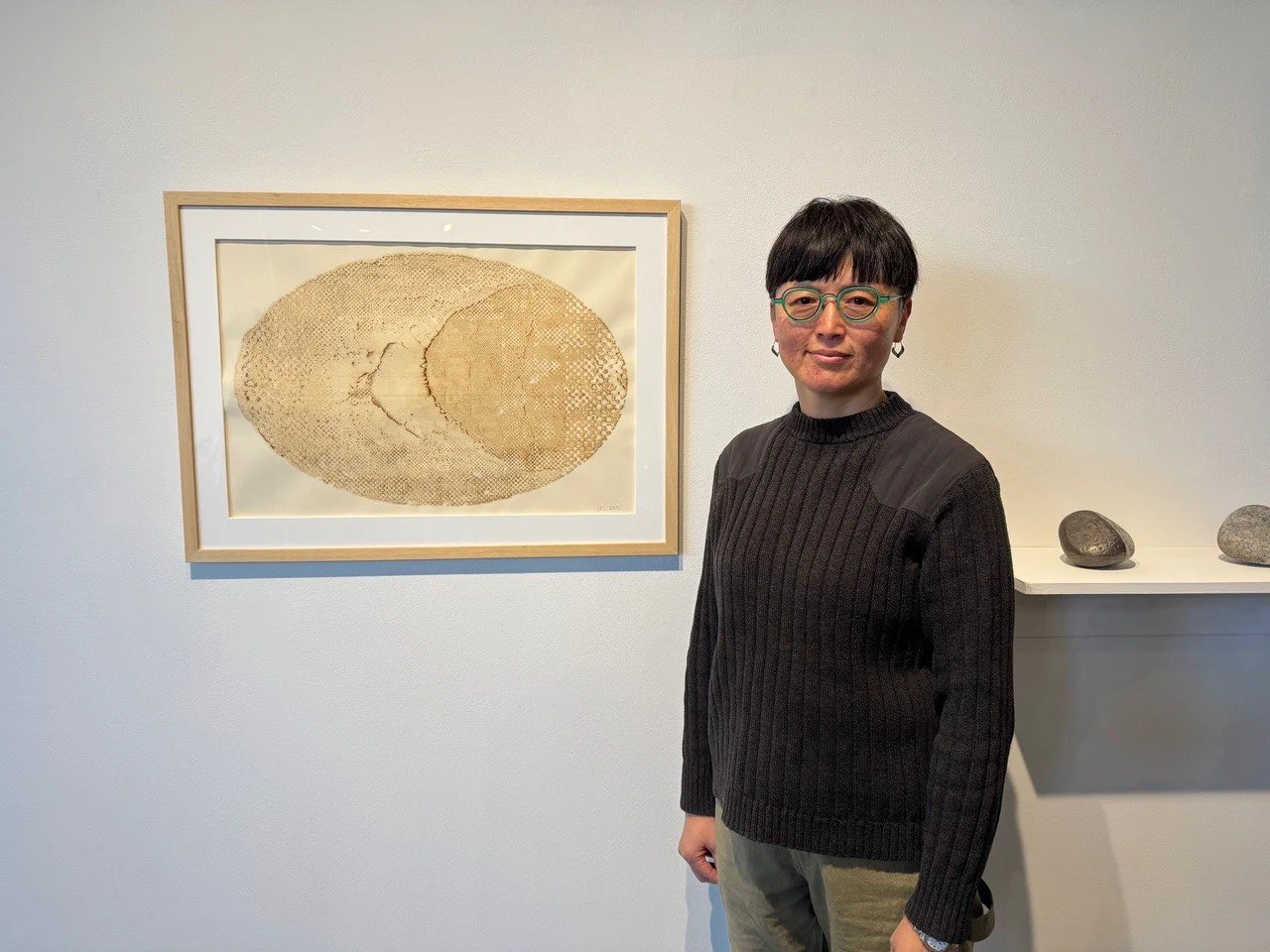
Hoshi, and her print was made using seaweed and leaves for ink.
From Nagoya City to a Quiet Peninsula
Hoshi grew up in Nagoya, one of Japan’s largest cities—a place of trains, traffic, and the famous grilled eel (unagi) that she still calls her favorite food. In Nagoya, eel is brushed with a rich, sweet sauce and served over rice, a regional style she carries with her wherever she goes. Only after moving to Maine did she discover that the elvers caught here are exported to Asia; it’s entirely possible that some of the eels she ate in Japan once swam along the Maine coast.
Today, her life looks very different. She lives in a small town on a peninsula in Steuben, surrounded by woods, tides, and granite ledges. There is space, both physically and mentally, to build a studio with her husband and to focus deeply on her work. The pace is quieter than city life in Japan, but that quietness has become one of her greatest teachers.
“Both Maine and Japanese life give me inspiration and learning,” Hoshi reflected. Her art is rooted in daily life, and now that daily life includes foggy mornings, tidal flats, and long walks by the shore.
Seaweed as a Bridge
One of Hoshi’s most meaningful Maine-Japan connections begins at the water’s edge. In recent years, she has started using seaweed, specifically rockweed, as a material for her silkscreen prints. Walking the peninsula near her home, she noticed the seaweed clinging to rocks along the shore. As someone raised in a culture where seaweed is a familiar part of daily cuisine, her curiosity was immediate: what was this seaweed, and why did it feel so familiar and yet so new?
Research led her to “rockweed,” a species that lives only in this particular coastal zone. For Hoshi, that specificity became symbolic. The seaweed is tied to place, marking exactly where she lives now. “If I didn’t grow up in Japan, I might not pay attention to the seaweed,” she noted. Her Japanese upbringing taught her to notice it; her Maine surroundings turned it into an artistic material. Seaweed became a quiet bridge between her two homes: one in Nagoya, one on the rocky Maine coast.
Teaching Japanese Stone in Maine Granite
Hoshi’s artistic life hasn’t stayed confined to her own studio. Over the years, she has shared her craft and perspective with students and communities across Maine.
Educated in Japanese art schools, she trained in traditional stone carving methods, often working with hard stone. When the Maine College of Art & Design (MECA&D) invited her and her husband to teach, they asked her to create a stone carving class. Looking around, she saw an obvious opportunity: Maine is full of granite and historic stone quarries. They decided to bring Japanese stone-carving methods into conversation with local stone.
Her experience in the classroom also revealed differences between the learning cultures she knew. Japanese students, she observed, tended to be very patient and focused. American students brought more variety in personality and learning styles. Hoshi adapted—keeping the rigor of Japanese technique, but making room for flexibility, with a variety of soft and hard stone experiences.
Beyond MECA&D, she has served as a visiting artist at the University of Maine in Orono and, with her husband, helped connect Japanese artists to Maine through events such as the Boothbay Sculpture Symposium and the Schoodic International Sculpture Symposium. Through these projects, artists from Japan and around the world have come to Maine to work with local stone, leaving permanent sculptures on the landscape.
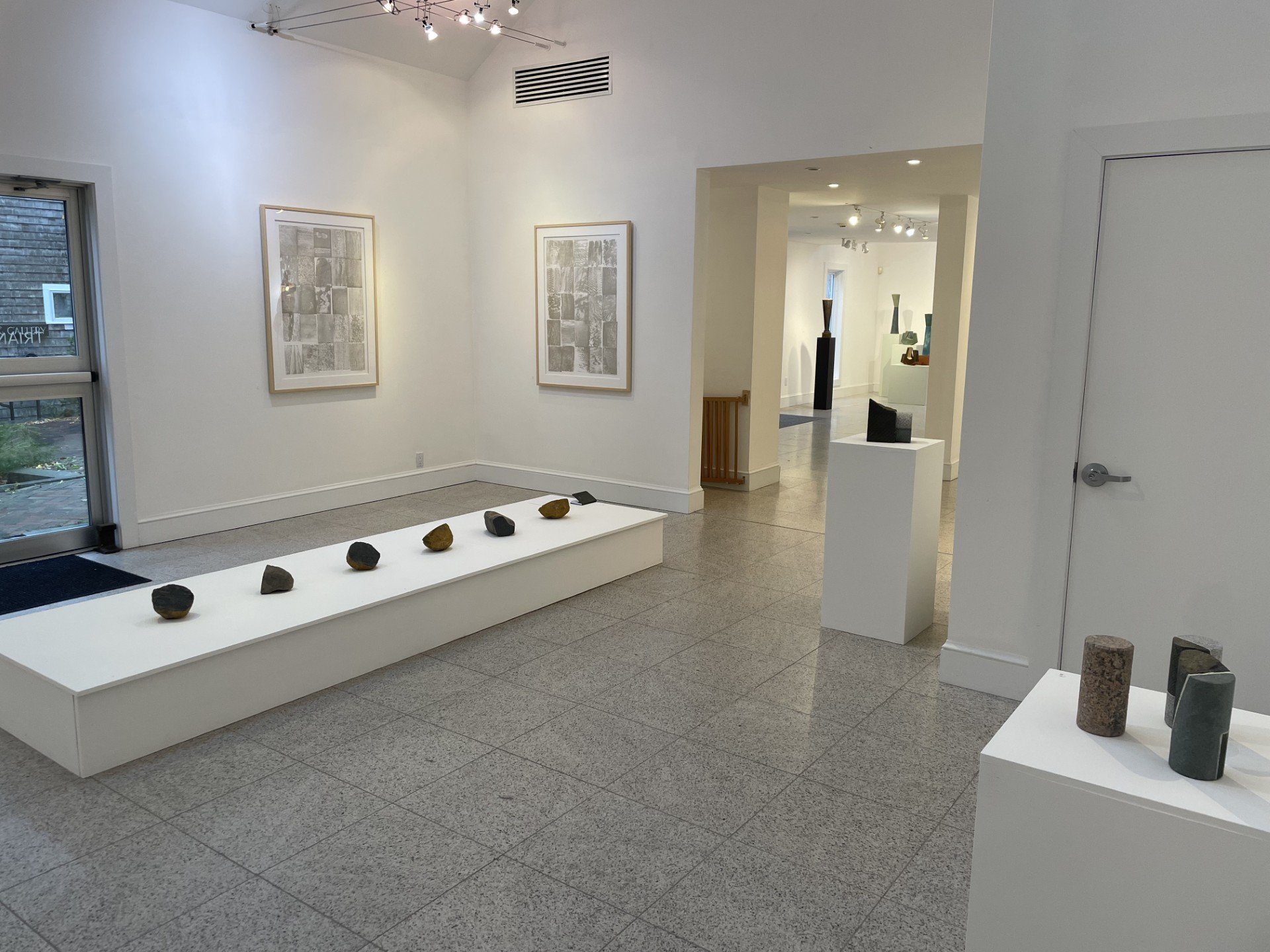
Hoshi’s recent four-person show for “Life Forms: Connect”, at Triangle Gallery in Rockland, Maine.
Dreams of a winter studio in Japan and Exchange
Before the pandemic, Hoshi and her family spent three winters on a small stone working island called “Kitagi-jima” in the Seto Inland Sea, where their children attended the island school, and the family explored the idea of a winter studio in Japan. They created small sculptures to send to the US, and her husband created and built a large sculpture for the island museum one winter. During their stays, Hoshi and Jesse also supported two sculpture symposia by Musashino Art University on the island. Hoshi and Jesse have continued introducing Japanese artists to Maine through symposiums, lectures, and visiting artist programs, and they keep seeking whatever new forms this cross-cultural exchange might take in the future.
At the end of the pandemic, Hoshi started a Master's Degree program in studio art at the School of the Art Institute of Chicago, an interdisciplinary study focusing on printing. She graduated in 2023.
Looking ahead, Hoshi’s family is planning another big step: they hope to live in Japan for one year, both to support her mother after major surgery and to give their daughter a new experience at an international school in Nagoya. It is, as she puts it, their “next journey.”
Two Homes, One Community
When Hoshi talks about cultural connection, she doesn’t choose between Maine and Japan.
“Now, both Japan and Maine are my homes,” she said. “Both countries’ connections and friendships are important to me. I want to respect and understand both Maine and Japan, and I want to care for and continue both relationships.”
That care shows up not only in her art, but in how she imagines community. Living in Maine, she has sought out other Japanese families: sharing meals, speaking Japanese at home so her children can grow up fluent in the language, and staying in touch with friends who weave making tofu, miso, and other Japanese traditions into Maine life.
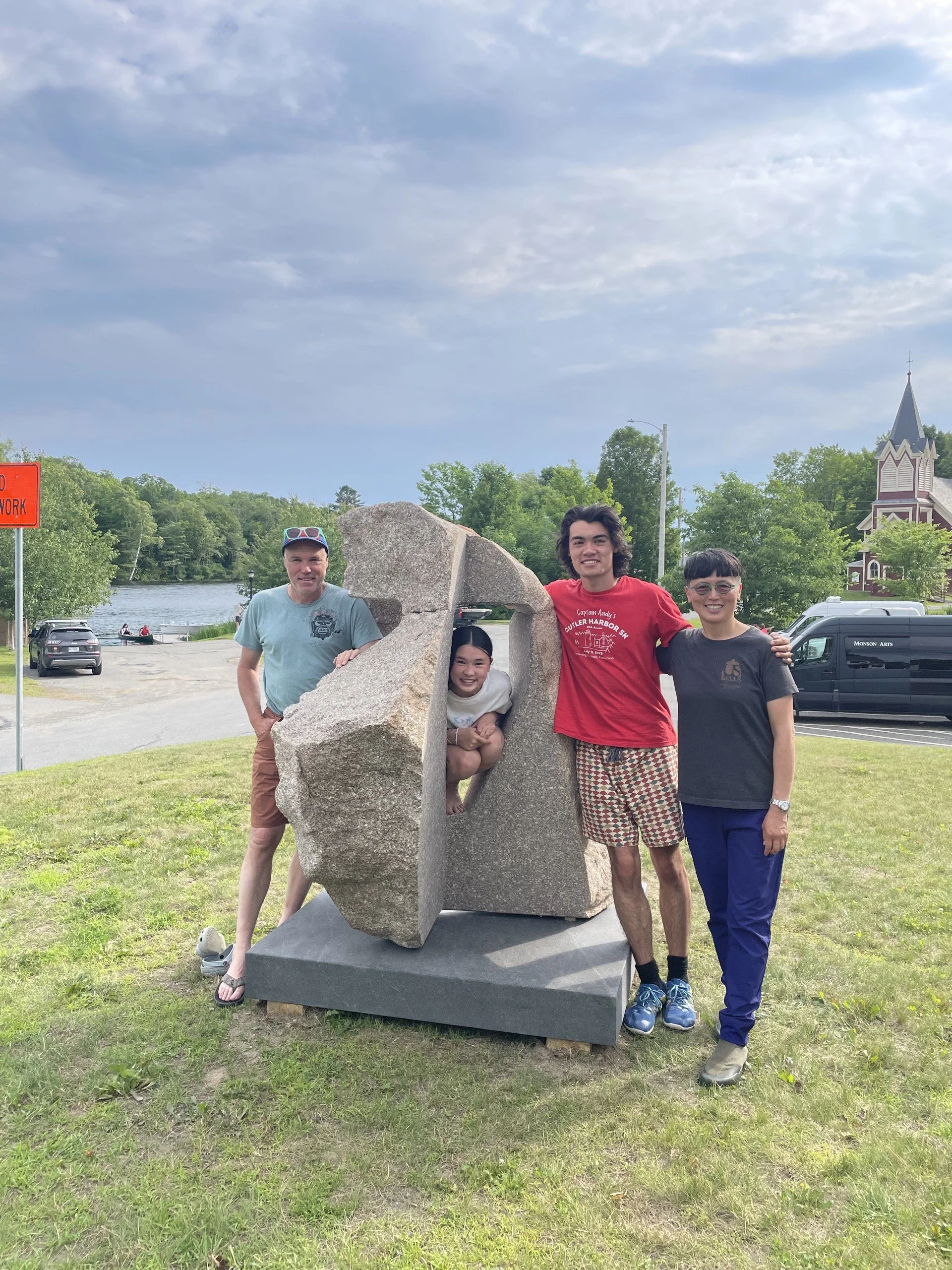
Hoshi’s sculpture, “Yohaku: Emptiness Beyond” with her family at Monson.
Looking Toward 2027 and Beyond
One upcoming project on the horizon is her participation in the Life Forms show at the Institute of Contemporary Art (ICA) at MECA&D in Portland, scheduled for January 2027. Between now and then, she will continue doing what she has quietly done for nearly two decades in Maine: walking her peninsula, watching the tides, noticing the seaweed, carving stone, and finding ways—large and small—to keep Nagoya and Steuben connected.
Find out more about Hoshi and her projects at:
https://kazumihoshino.com/biography/
https://www.instagram.com/khoshino5/
🌊 Subscribe for more Maine–Japan stories that celebrate culture, community, and creativity across the sea!
📩 Want to share your story? Email us: jcaofmaine@gmail.com.
📷 Follow us on Instagram: https://www.instagram.com/maine_japan/